
As enterprise agents move into production, the hardest question is often no longer whether the model can answer. It is whether the agent can safely understand and operate on real business data.
Data is scattered across BI semantic models, SAP data services, knowledge bases, databases, and many other business systems. The same business object may have different names, fields, granularities, and permission boundaries in different systems. If an agent can only guess database queries, API parameters, or business meanings from natural language, it is hard for an enterprise to trust it inside core processes.
Today, we officially release Data Xpert, a business operating system for enterprise agents.
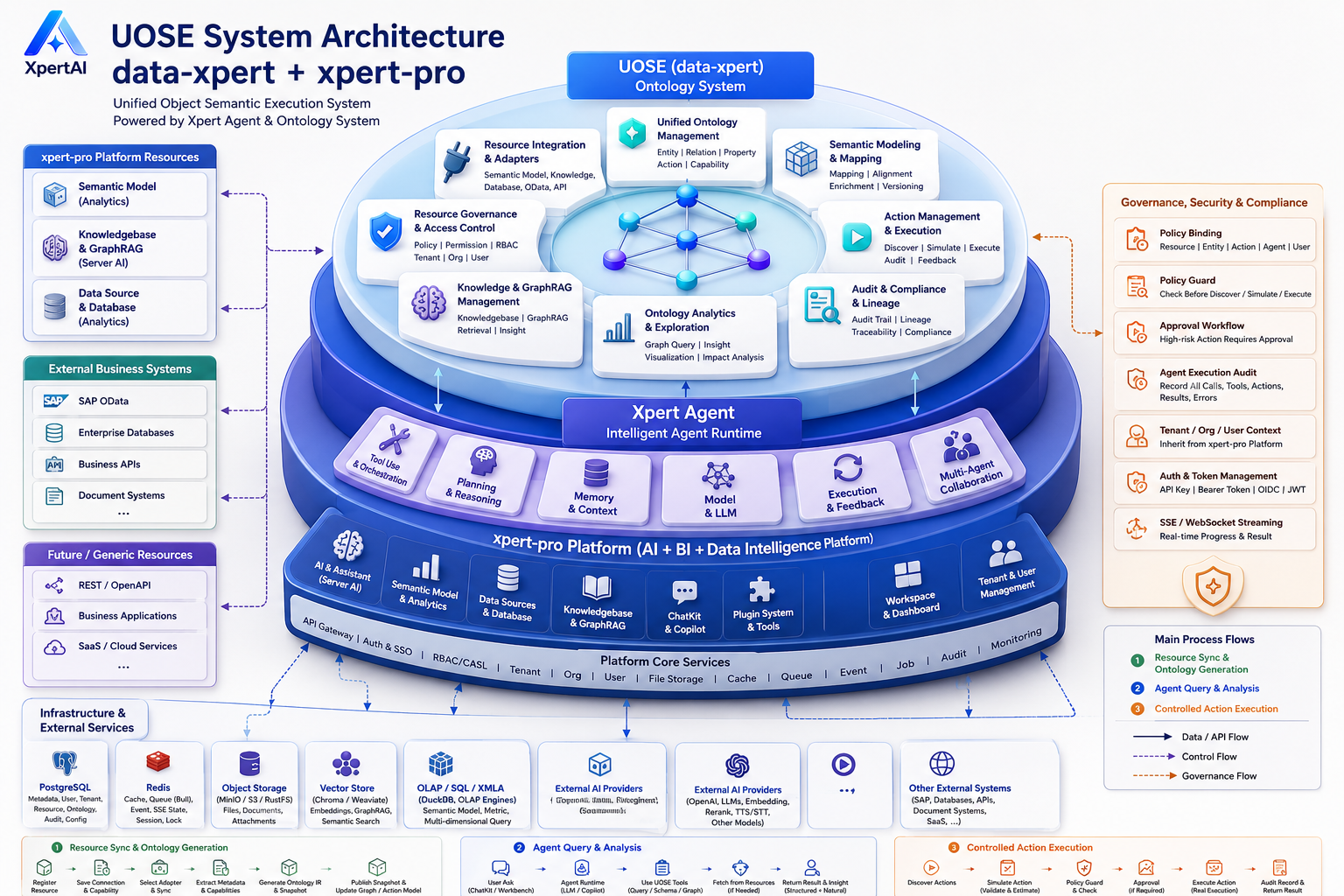
Data Xpert is not another static data catalog, nor is it a way for agents to bypass existing systems and call arbitrary interfaces directly. Its purpose is to build a unified object-semantic execution space on top of an enterprise's existing data and business systems: resources can be connected, objects can be understood, actions can be discovered, execution can be governed, and results can be traced.
From Data Catalog to Business Operating System
Traditional data catalogs mainly answer two questions: where assets are located, and what fields mean.
But when agents begin participating in business execution, enterprises need to answer many more questions:
- What can this object do?
- Do the current user and assistant have permission to use it?
- Does it support query, preview, analysis, creation, or update?
- Can execution be simulated and validated first?
- Do high-risk actions require approval?
- After execution, how can inputs, outputs, policies, and evidence be traced?
Data Xpert is designed around exactly these questions. It turns enterprise resources into an object space that agents can use, giving metrics, models, tables, fields, SAP entity sets, knowledge entities, and business actions clear semantics, relationships, constraints, and execution boundaries.
Under the hood, Data Xpert uses UOSE, the Unified Object Semantic Execution system. You can think of it as a semantic control plane and governed execution plane that sits in front of enterprise resources before agents access them.
Unified Access to Enterprise Data, Knowledge, and Business Systems
The first capability Data Xpert provides is unified resource access.
Administrators can manage connection credentials through secret management, register resources in the resource registry, and configure sync scope, query limits, service allowlists, and runtime parameters through capability forms for each resource type. After a resource is connected, the system uses sync jobs to pull external metadata into Data Xpert and generate semantic objects that can later be used by ontology, agent tools, and governance modules.
The current product line covers these resource types:
- Semantic models: connect Xpert semantic models, multidimensional cubes, metrics, measures, and dimensions.
- SAP data services: connect SAP OData services, entity sets, entity types, and business operations.
- Graph-enhanced retrieval knowledge bases: connect xpert-pro knowledge-base graphs, bringing document evidence and entity relationships into agent context.
- Enterprise databases: connect data-source metadata for tables, fields, relationships, previews, and query analysis.
These resources use very different protocols, but once they enter Data Xpert, they are converted into unified entities, relationships, properties, actions, and policy objects. For agents, this means they do not need to understand every system's internal details directly. They can complete discovery, analysis, and execution through a stable object-semantic protocol.
Give Data Ontological Semantics Agents Can Understand
Resource access is only the first step. To make agents work reliably, resources also need business semantics that can be understood, searched, and verified.
Data Xpert's ontology semantic layer synchronizes external resources into ontology snapshots, then further projects them into runtime entity, relationship, and action instances. Administrators can use the ontology workspace to view the snapshot status of each resource, search entities across resources, inspect graph relationships, and enter a single-resource graph to review nodes, edges, properties, and raw value summaries.
This step is critical. An agent should not guess business objects only from page text or chat history. It should first locate the object, then inspect its upstream and downstream relationships and structural definitions, and only then decide which actions are currently available.
A more reliable business flow looks like this:
- First confirm which business object the user is really looking for.
- Then inspect that object's key properties, upstream and downstream relationships, and available data.
- Determine which analysis, query, or business operations it is currently allowed to execute.
- Complete parameter, permission, and risk validation before formal execution.
- After execution, return results, evidence, and audit records to the user.
This path moves agents away from "guessing answers" and toward "working inside a verifiable object space."
Agent Tools, Protocol Access, and Conversational Workbench
Data Xpert provides standard tool capabilities for agents, including entity search, relationship reading, ontology structure queries, action discovery, action simulation, action execution, and audit tracing.
These capabilities can be used through standard interfaces, or exposed to business assistants through a Model Context Protocol service. For frontend users, Data Xpert provides an interactive execution experience through ChatKit and the assistant workbench: users can start a conversation in the context of the current resource, current ontology graph, or current business assistant, and let the agent analyze and operate with that context.
Execution results are not just returned as text. Data Xpert can render semantic model query results, OData collection data, database query results, and knowledge graph evidence as tables, charts, evidence cards, or downloadable data, making the agent's output closer to the deliverables business users can actually use.
This is also what separates Data Xpert from ordinary chat entry points. It does not ask users to "ask a model." It lets users collaborate with a governable agent inside an enterprise data-object and business-operation space.
Governance, Approval, and Audit Are Defaults for Production
For enterprise agents to enter real business operations, governance must be part of the default design, not an afterthought.
Data Xpert includes policy bindings, approval queues, and execution audit. Administrators can configure allow, deny, or approval-required rules around resources, actions, and entity types. When an agent discovers actions, simulates execution, or performs real execution, every step goes through policy evaluation. High-risk actions can enter an approval queue, and completed executions leave behind the task, resource, action, target object, policy result, inputs and outputs, and audit references.
At the same time, Data Xpert works with XpertAI's workspace, user groups, and published-agent access-control system. Business assistant visibility and runtime permissions are no longer scattered across local role tables. They are managed uniformly around workspaces, user groups, and published agents. Frontend menus are not the security boundary; when a ChatKit session is created, the backend still revalidates assistant status, workspace access, and published access.
This lets enterprises place agents inside real organizational structures, instead of running them only in demo environments.
A Clearer Path to Deployment
A typical Data Xpert workflow is direct:
- An administrator creates connection secrets and registers semantic model, SAP data service, knowledge-base, or database resources.
- The system synchronizes resource metadata and generates ontology snapshots plus entity, relationship, and action projections.
- The administrator validates the semantic graph and entity search results in the ontology workspace.
- The agent builder binds accessible resources to a business assistant and configures workspace, user groups, runtime environment, toolsets, and runtime credentials.
- Business users start analysis, query, explanation, or controlled execution through ChatKit in the assistant workbench.
- High-risk actions enter approval, and executed actions retain audit trails.
This chain brings together capabilities that used to be scattered across data platforms, business systems, permission systems, chat entry points, and audit logs into a business operating system for agent production.
Why Data Xpert Matters
The release of Data Xpert marks a deeper stage in XpertAI's enterprise agent journey.
If the agent platform answers how agents are built, orchestrated, and run, and ChatKit answers how agents are embedded into product experiences, then Data Xpert answers how agents can reliably enter enterprise data and business systems.
It lets enterprises connect resources in a unified way, organize business objects through ontological semantics, constrain agent execution with agent tools, and protect production boundaries with policies, approvals, and audit. Ultimately, the agent is no longer just an interface that can answer questions. It becomes a digital collaborator that can keep working on top of enterprise business objects.