Agent and Workflow Hybrid Architecture
In today's rapidly evolving AI landscape, enterprises face a critical dilemma: how to balance the creativity of LLMs with the stability of processes? While purely agent-based architectures offer flexibility, they are difficult to control; traditional workflows, though reliable, lack adaptability. The Agent and Workflow Hybrid Architecture of the Xpert AI platform is designed to resolve this conflict — it allows AI to possess "free will" while adhering to "rules and order."
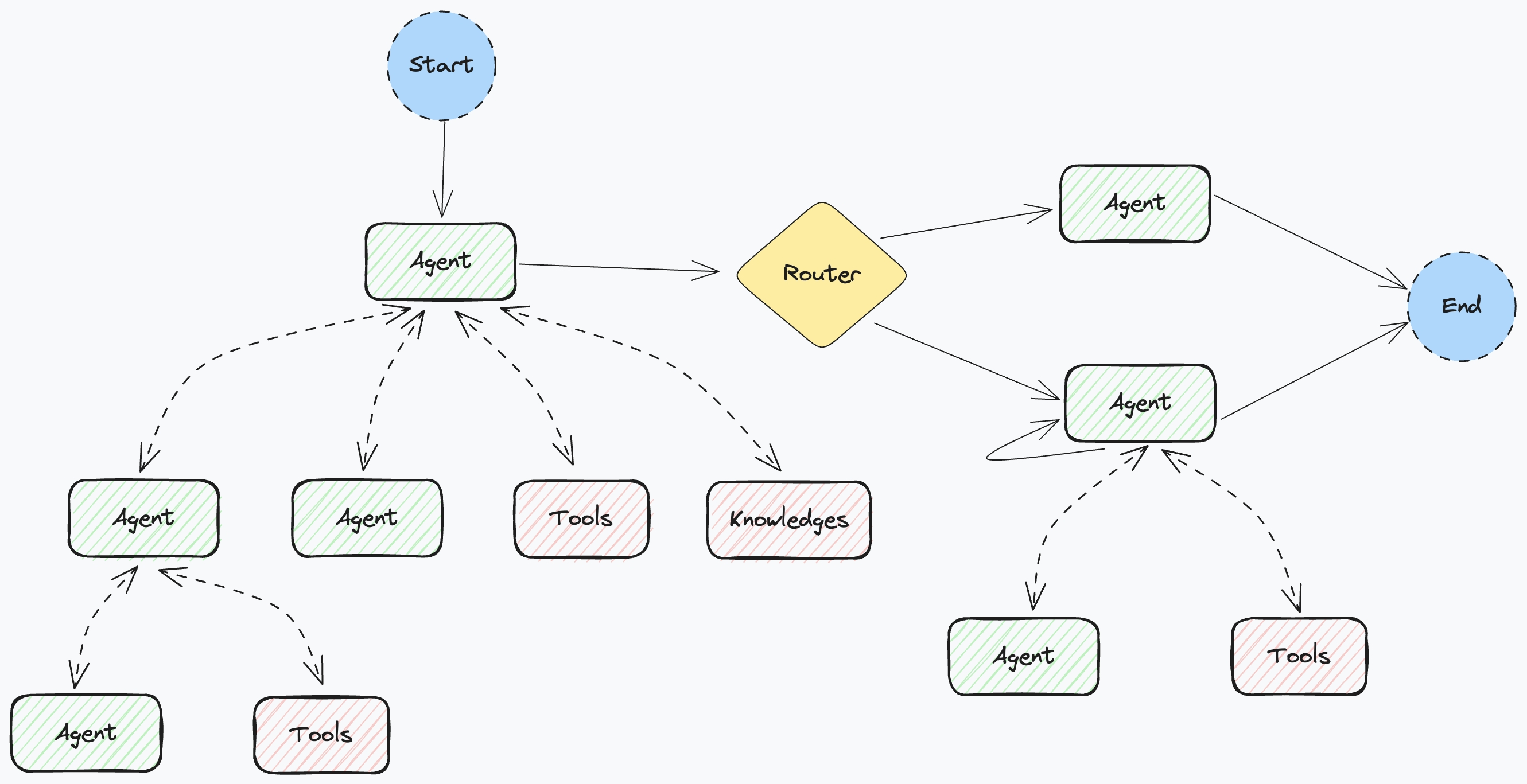
Agent-Workflow Hybrid Architecture
I. Core Philosophy of Architecture Design
"Let the right tool do the right job."
The essence of the hybrid architecture lies in dynamically adapting to task requirements, achieving an optimal balance between efficiency and flexibility through the collaboration of two modes:
- Agent Mode (High Autonomy)
- Use Cases: Open-domain dialogue, creative generation, complex decision-making
- Technical Features:
- Autonomous reasoning and tool invocation based on LLMs
- Supports dynamic strategy adjustments (e.g., real-time learning of user preferences)
- Example: Automatically analyzing emotions and generating personalized compensation plans during customer complaints
- Use Cases: Open-domain dialogue, creative generation, complex decision-making
- Workflow Mode (High Control)
- Use Cases: Data cleaning, API calls, approval chains
- Technical Features:
- Predefined standardized operation sequences
- Ensures repeatable and auditable results
- Example: Strictly verifying risk control rules during order payments
- Use Cases: Data cleaning, API calls, approval chains
- Hybrid Collaboration Mechanism
- State Sharing: Data is passed through unified session variables to avoid information silos
- Dynamic Switching: Both modes can be alternated multiple times within a single process
- Cost Optimization: LLM inference is triggered only when necessary (e.g., using workflow rules to replace basic LLM judgments)
- State Sharing: Data is passed through unified session variables to avoid information silos
II. Breakthroughs in Architecture Implementation
1. Dynamic Routing Engine
Intelligent decision distribution through big model:
- Routing strategy: The big model performs real-time reasoning based on context, user intent, and task complexity, and dynamically selects the best processing node
- Horizontal and vertical strategies: Supports horizontal routing and vertical autonomous tool strategies to achieve hierarchical processing of complex tasks.
2. State-Aware System
- Global State Management:
- All nodes read and write to a unified context via session variables
- Version control at the variable level (e.g., tracing historical states of decisions)
- All nodes read and write to a unified context via session variables
- Side Effect Isolation:
- Trial-and-error operations by agents are executed in a sandbox, updating the main state only after confirmation
III. Value Validation in Real-World Scenarios
Case: Cross-Border E-Commerce Customer Service System
User inquiry → Workflow (structured parsing of order number) → Router node →
  ├→ If return/exchange is needed → Workflow (calling ERP interface to verify policy) → Agent (generating multilingual solutions)
  ├→ If product inquiry → Agent (real-time retrieval from knowledge base + LLM explanation)
  └→ If complaint escalation → Workflow (generating work order) → Human agent ← Agent (providing script suggestions)
- Results:
- Customer service response speed increased by 40%
- LLM invocation costs reduced by 65% (via workflow pre-filtering)
- Customer satisfaction rose from 78% to 92%
- Customer service response speed increased by 40%
IV. Enhanced Developer Experience
1. Visual Orchestrator
- Drag-and-drop connection of agent and workflow nodes
- Real-time visualization of data flow paths
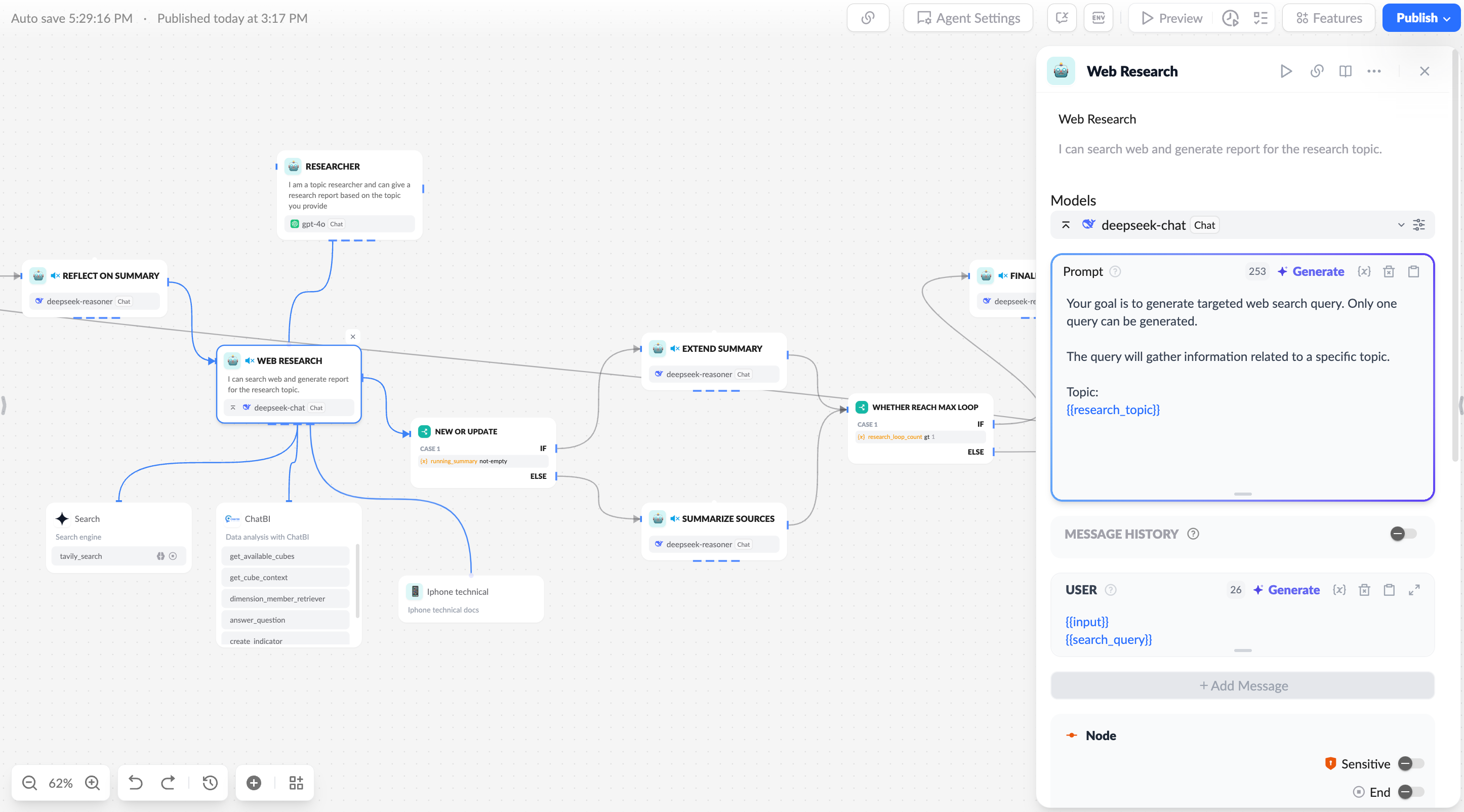
Hybrid Architecture Orchestration Interface
2. Debugging Toolchain (Under Development)
- State Time Machine: Roll back to any historical node for re-execution
- AI-Assisted Diagnostics: Automatically locate abnormal nodes and recommend fixes
V. Future Directions for Architecture Evolution
- Agent Federated Learning
- Cross-process sharing of agent experience and memory
- Self-Evolving Workflows
- Automatically optimize node sequences through LLM analysis of execution logs
- Quantum Decision-Making
- Introduce probabilistic branching at the routing layer (e.g., exploring multiple paths simultaneously and selecting the best)
Conclusion
The hybrid architecture of Xpert AI is not merely a technical patchwork but a rethinking of AI engineering paradigms. It proves a fundamental truth: in a world where certainty and uncertainty coexist, only an "elastic architecture" can enable AI to truly create value. When your next AI project requires balancing rigorous processes with bursts of inspiration, this architecture may well be the key to unlocking success.
Let machines think like humans, but be more reliable than humans —this is the ultimate goal of the hybrid architecture.